


.svg)
.png)




Share this
by William Toll on Sep 17, 2025 9:20:27 AM
Quick Answer: How Much Should Companies Spend on Cybersecurity in 2026?
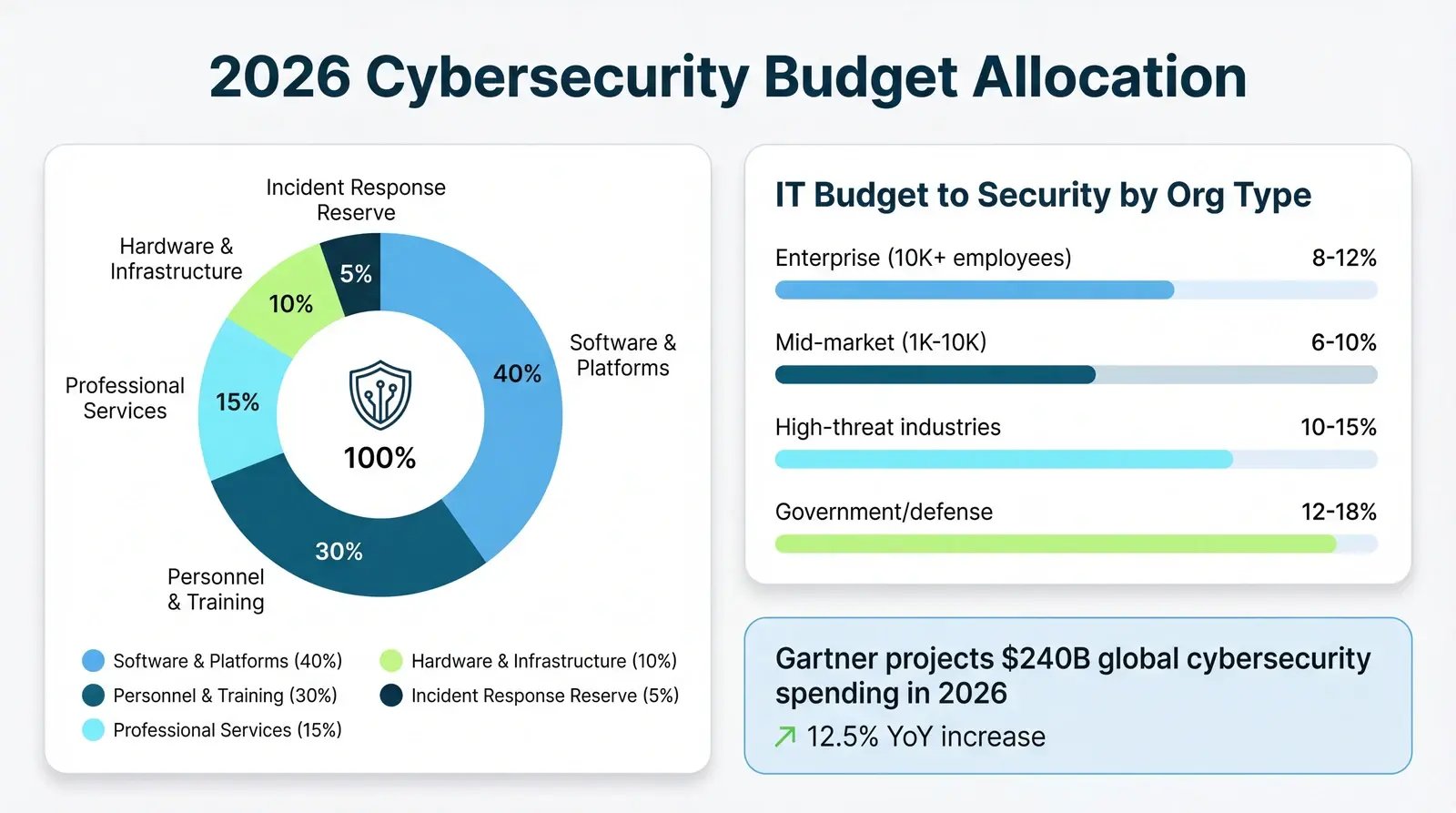
Gartner projects global cybersecurity spending will reach $240 billion in 2026, a 12.5% increase over 2025. For most enterprises, security should consume 8 to 12% of your total IT budget, rising to 10 to 15% for organizations in high-threat industries like healthcare and financial services. Within that budget, the typical allocation splits roughly 40% to software and platforms, 30% to personnel, 15% to hardware, and 15% to outsourced services. This guide covers benchmarks by industry, spending trends, and ROI frameworks to help you plan your 2026 cybersecurity investment.
2026 Cybersecurity Budget: Key Numbers
$240B
Gartner's 2026 global spending forecast
$4.88M
Average data breach cost (IBM 2024)
48 min
Average time to lateral movement
149%
Ransomware spike, early 2025
4.8M
Unfilled cybersecurity positions
670
New OT vulnerabilities in H1 2025
What the Numbers Say: Global Spending Forecast
After a year of conservative budgets, 2026 marks an inflection point for cybersecurity spending. According to Gartner, worldwide end-user spending on information security will reach $240 billion in 2026, up from $213 billion in 2025. That's a 12.5% year-over-year increase, a significant acceleration from 2025's 4% growth rate (the slowest expansion in five years). Forrester projects global information security spending will approach $200 billion, while Cybersecurity Dive's analysis puts the combined security and risk management figure even higher at $262 billion.
These aren't abstract numbers. They reflect the gap between current defenses and a threat landscape that's evolving faster than most budgets anticipated. If you're a CISO or IT leader preparing your 2026 plan, these forecasts provide the market context you need to benchmark your own spend.
Gartner, Forrester, and the $240 Billion Projection
The scale of the spending increase deserves scrutiny. Here's how the three major forecasts compare:
| Analyst Firm | 2026 Projection | Growth Rate | Scope |
|---|---|---|---|
| Gartner | $240 billion | 12.5% YoY | Information security end-user spending |
| Forrester | $200 billion+ | Moderate acceleration | Information security spending |
| Cybersecurity Dive | $262 billion | Strong expansion | Security and risk management |
The variance reflects different measurement scopes: Gartner and Forrester focus on information security spending, while broader risk management analyses capture adjacent categories like privacy compliance, identity governance, and security consulting. What's consistent across all three: organizations are spending more, and the rate of increase is accelerating.
Two factors explain the shift. First, 2025 was a year of belt-tightening where many CISOs focused on consolidating tools rather than purchasing new ones. Second, the rise of AI-driven attacks and the steady drumbeat of ransomware incidents have made cybersecurity a board-level priority that's harder to defer.
Regional Spending Trends: Where Growth Is Fastest
Security spending isn't growing uniformly across geographies. According to Forrester's Security Planning 2026 Budget Guide, regional disparities are widening:
| Region | Orgs Expecting >10% Growth | Overall Trend | Key Drivers |
|---|---|---|---|
| Asia-Pacific | 22% | Aggressive catch-up | Historical underinvestment, regional threat escalation |
| Europe | 14% | 81% expect increases | Regulatory compliance (NIS2, DORA), threat response |
| North America | 9% | Conservative, optimization-focused | Existing investment optimization, platform consolidation |
Asia-Pacific stands out: 22% of organizations expect budget increases exceeding 10%, more than double North America's 9%. This reflects years of underinvestment catching up with a threat environment that doesn't respect geography. European organizations are responding to NIS2 and DORA regulatory requirements, with 81% expecting budget increases of some size.
Four Forces Driving Budget Increases
Across all regions, four forces are compelling CISOs to push for larger budgets in 2026:
- AI-powered threat evolution. Attackers can now generate 10,000 personalized phishing emails per minute using generative AI, rendering static defenses insufficient.
- Deepfake fraud surge. Deepfake-enabled fraud incidents increased 3,000% in 2024, forcing organizations to reassess authentication and identity verification controls.
- Board-level engagement. Cybersecurity is now recognized as a core fiduciary duty, with directors and officers increasingly accountable for security posture.
- Regulatory pressure. New and evolving compliance mandates (CMMC 2.0, CIRCIA, updated HIPAA, IEC 62443) are creating mandatory spending floors that can't be deferred.
The Threat Landscape Behind the Budget
Budget numbers don't exist in a vacuum. The spending acceleration reflects a threat landscape where attackers are faster, better funded, and harder to detect than in any prior year. Understanding these threats is essential for allocating your cybersecurity budget effectively.
How Fast Attackers Move Now
According to Cybersecurity Ventures, global cybercrime damages will exceed $9.5 trillion in 2025. The American Hospital Association reported 364 healthcare hacking incidents affecting 33 million people in 2025 alone. These numbers illustrate the scale, but the speed's what should concern you most.
CrowdStrike and ReliaQuest data show that the average time from initial compromise to lateral movement has dropped to 48 minutes, down from 62 minutes in 2023, a 22% acceleration. The worst-case breakout time is just 51 seconds. And 30% of intrusions now rely on legitimate credentials rather than malware, making detection even harder. Another one in five intrusions (22%) exploit unpatched vulnerabilities. For more on how attackers traverse networks, see our guide to understanding and preventing lateral movement.
Your cybersecurity budget needs to account for this speed. Traditional tools that take hours or days to detect and contain threats leave a window that attackers are specifically designed to exploit. When the average time to lateral movement is 48 minutes, a detection tool that fires alerts within four hours is already too late. Budget accordingly: invest in controls that work at machine speed (microsegmentation, automated response) rather than relying solely on human-paced investigation workflows.
Ransomware Economics: Why Prevention Pays
Ransomware attacks surged 149% in the first five weeks of 2025, according to TotalAssure. Globally, a ransomware attack now hits some organization every 19 seconds. Average ransom payments have climbed from $400,000 in 2023 to $2 to 3 million in 2024 and 2025, and that figure doesn't include recovery costs, lost revenue, and regulatory fines.
What's changed tactically: according to Sophos, 63% of ransomware incidents exploited unpatched vulnerabilities. Double and triple extortion (encrypting data, threatening to leak it, and targeting customers directly) is now standard. Meanwhile, edge device exploitation has made an eight-fold jump, rising from 3% to 22% of all breaches according to Verizon's DBIR. Firewalls, VPNs, and load balancers that were once your perimeter are now common entry points.
The economics are clear: investing in preventing ransomware through microsegmentation and other proactive controls costs a fraction of what a successful attack will extract. A ransomware attack that might cost $5 to 10 million in damages can be contained to a single network segment, reducing impact to $500,000 or less, when proper segmentation is in place.
OT and Medical Device Risk Is Surging
Operational technology and medical devices represent one of the fastest-growing risk categories. IBM X-Force reported a 146% jump in attacks designed to cause physical damage to industrial systems. Nation-state attacks on OT environments tripled in 2024. In the first half of 2025 alone, 670 new OT vulnerabilities emerged, with 21% having public exploit code available within days of disclosure. The average cost of an OT-impacting breach reached $4.56 million (IBM 2024).
Medical devices present a parallel challenge. According to Claroty's Team82 research, 99% of hospitals have devices with known exploitable vulnerabilities. Fifty-three percent of networked medical devices carry critical security flaws. Fourteen percent run on end-of-life operating systems that no longer receive patches. Eighty-nine percent have ransomware-linked vulnerabilities accessible from the internet. Only 13% of these devices support standard endpoint security agents, making traditional security tools ineffective.
Organizations are responding: HelpNetSecurity reports a 75% increase in medical device security spending. Yet only 17% of security leaders feel confident in their ability to detect attacks against these devices. For organizations managing complex OT environments, our OT asset inventory guidance provides a practical starting point.
The Skills Shortage Tax on Every Budget
The cybersecurity workforce gap has reached 4.8 million unfilled positions worldwide, a 19% year-over-year increase. This shortage directly inflates every other budget line. In 2024, 37% of organizations experienced budget cuts, and 25% imposed hiring freezes or staff reductions. According to IBM, organizations with staffing shortages experience breach costs $1.76 million higher than well-staffed peers.
The most critical skills gaps, according to Deepstrike: cloud security (30% of organizations report gaps), AI and ML security (34%), and Zero Trust implementation (27%). Yet only 11% of security executives feel their teams are adequately staffed. This means every dollar you spend on security tools needs to account for whether your team can actually operate them, a reality that's pushing more organizations toward managed services and platforms that reduce operational complexity.
Compliance Mandates Reshaping 2026 Budgets
Regulatory requirements have shifted from aspirational frameworks to enforceable mandates with real deadlines and penalties. The compliance landscape in 2026 is defined by converging deadlines across multiple frameworks, each carrying financial consequences for non-compliance. If you haven't budgeted for these, you're already behind.
CISA Zero Trust and NIST CSF 2.0
The CISA Zero Trust Maturity Model defines five pillars (Identity, Devices, Networks, Applications and Workloads, Data) with three maturity stages: Traditional, Advanced, and Optimal. Moving from Traditional to Advanced typically requires 12 to 24 months and 15 to 25% of annual security budgets.
NIST's Cybersecurity Framework 2.0, its first major update since 2014, introduced a new "Govern" function that pushes cybersecurity governance directly into boardroom oversight. For budget planning, NIST CSF 2.0 suggests this allocation across functions: Identify (20%), Protect (35%), Detect (20%), Respond (15%), and Recover (10%). Combined with NIST SP 800-171 Rev. 3 for protecting Controlled Unclassified Information (CUI), these frameworks are increasingly referenced in procurement requirements and contract language.
For organizations with a zero trust architecture implementation guide, these percentages provide useful starting benchmarks for aligning security investments with recognized frameworks.
CMMC 2.0, CIRCIA, and Federal Deadlines
Two federal mandates are creating urgent budget requirements in 2026:
CMMC 2.0 Phase 1 runs through late 2026. Level 2 certification aligns with 110 NIST SP 800-171 requirements, and certification costs range from $200,000 to several million dollars for mid-sized defense contractors. Organizations pursuing DoD contracts without CMMC certification will be locked out of the bidding process. For a detailed breakdown, see our guide to CMMC 2.0 compliance and network security alignment.
CIRCIA (Cyber Incident Reporting for Critical Infrastructure Act) reaches full effect in May 2026. Covered entities must report significant incidents within 72-hour windows. Building the detection, documentation, and reporting capabilities to meet these requirements typically costs $150,000 to $400,000. Non-compliance penalties can reach into the millions. For healthcare-specific implications, see our CIRCIA healthcare compliance requirements analysis.
Healthcare, Manufacturing, and Sector Rules
Industry-specific regulations are further reshaping cybersecurity budget priorities:
- Healthcare: The proposed HIPAA Security Rule updates would shift network segmentation from an "addressable" safeguard to a mandatory requirement. Organizations that haven't budgeted for segmentation should plan now. Our analysis of HIPAA security rule changes and segmentation requirements covers the technical implications.
- Manufacturing: IEC 62443 adoption is accelerating, with implementation timelines of 18 to 36 months and budgets of $3 to 8 million for mid-sized facilities. For details on OT segmentation requirements, see our guide to IEC 62443 segmentation requirements for OT.
- Critical infrastructure: NERC CIP standards for energy, EPA requirements for water systems, and TSA pipeline directives all mandate documented security controls. Cyber insurance providers now require evidence of network segmentation and microsegmentation as baseline coverage conditions.
Across sectors, insurance carriers are requiring MFA, EDR, microsegmentation, and immutable backups before issuing or renewing policies. Organizations with documented microsegmentation implementations report premium reductions of 15 to 30%, making the security investment partially self-funding.
Where the Money Goes: Allocation Benchmarks
Understanding how organizations allocate their cybersecurity budgets provides essential context for your own planning. Whether you're building a first-time security budget or optimizing an existing one, benchmarking against industry peers gives you the data you need for credible board presentations. The benchmarks below draw from Forrester, Gartner, IBM, and NuHarbor Security research across hundreds of enterprise security programs.
Category-by-Category Spending Breakdown
According to Forrester's 2026 Budget Planning Guide, the typical enterprise cybersecurity budget breaks down as follows:
| Budget Category | % of Total Budget | 2025 to 2026 Trend | Key Drivers |
|---|---|---|---|
| Software/Security Tools | ~40% | Increasing | Platform consolidation, AI-driven tools |
| Internal Personnel | ~30% | Stable | Talent shortage constraining growth |
| Hardware/Appliances | ~15% | Declining | Shift to software-defined security |
| Outsourced Services | ~15% | Increasing | Skills gap, 24/7 monitoring needs |
| Training & Governance | 5-10% | Stable | Compliance requirements, awareness programs |
Two trends stand out. Software now commands roughly 40% of enterprise security budgets, surpassing combined spending on hardware and outsourced services. This reflects a market-wide movement away from appliance-based models toward integrated platforms that support hybrid and multi-cloud environments. Hardware expenditures have contracted to approximately 15% as organizations embrace software-defined security, and for good reason: the hidden costs of firewall complexity extend well beyond the purchase price.
When you include both internal staff and external contractors, personnel costs represent approximately 51% of total security spending (NuHarbor Security). Yet only 11% of security executives believe their teams are adequately staffed. This persistent gap is pushing outsourced services growth, particularly for MSSP engagements providing 24/7 monitoring and specialized threat hunting.
What Percentage of IT Budget Goes to Security
One of the most common cybersecurity budget questions is: "What percentage of our overall IT budget should go to security?" The answer depends on your industry, risk profile, and regulatory obligations.
| Organization Type | Security as % of IT Budget | Notes |
|---|---|---|
| High-threat industries (healthcare, finance) | 10-15% | Regulatory pressure, high breach costs |
| Average enterprise | 8-12% | Growing 8-12% year over year |
| Transformation/recovery year | 15-20%+ | Consulting fees and platform deployment spikes |
| SLED organizations | Varies widely | Over one-third of state CISOs report no dedicated budget |
According to Gartner, security should consume 10 to 15% of IT budgets for organizations facing high threat exposure. The typical enterprise is allocating 8 to 12%, with that percentage growing at a rate of 8 to 12% year over year. If your organization is in a transformation year (post-breach recovery, major platform migration, or first-time Zero Trust deployment), expect to temporarily allocate 15 to 20% or more, driven by consulting fees and platform deployment costs.
SLED (state, local, education, and district) organizations face the most constrained environment. Over one-third of U.S. state CISOs report lacking any dedicated cybersecurity budget, forcing them to absorb security costs within general IT operations.
Financial services organizations typically sit at the high end of the range (10 to 15%), driven by stringent regulatory requirements and the direct financial consequences of breach events. Healthcare organizations are catching up, with security budgets growing faster than any other sector as ransomware costs and HIPAA enforcement intensify. If you're benchmarking your security spend against peers, remember that the percentage alone doesn't tell the full story. A 12% allocation on a $50 million IT budget produces very different outcomes than 12% on a $500 million budget. Absolute dollar amounts, not just percentages, matter for staffing and tooling decisions.
Industry Benchmarks: Healthcare, Manufacturing, Critical Infrastructure
Industry-specific benchmarks reveal the true cost variance across sectors. Whether you're benchmarking against peers or building a board presentation, these data points give you defensible reference ranges.
| Industry | Avg Breach Cost | Key Budget Priority | Microseg Investment | Compliance Driver |
|---|---|---|---|---|
| Healthcare | $7M+ (highest) | Medical device security: 20-25% of budget | $1-4M initial, $400K-$1.2M/yr ops | HIPAA mandatory segmentation |
| Manufacturing | $4.56M (OT) | OT/IT segmentation, IP protection: 15-20% | IEC 62443: $3-8M, 18-36 months | IEC 62443, FDA OT guidance |
| Critical Infrastructure | Varies | SIEM, IR, compliance programs | 10-15% of budget for compliance | CIRCIA May 2026, NERC CIP |
Healthcare carries the highest average breach cost of any industry at over $7 million (IBM 2024). Sixty-seven percent (67%) of healthcare organizations were hit by ransomware in 2024, with 53% suffering data encryption. The average recovery time stretches to 291 days. Ransomware costs per healthcare incident average $10 million when factoring in operational disruption, diverted ambulances, and cancelled procedures. A 500-bed hospital should budget $1 to 4 million for initial medical device security deployment and $400,000 to $1.2 million annually for operations.
Manufacturing organizations face an OT-specific breach cost averaging $4.56 million. Production downtime alone costs $2 million per day for automotive manufacturers and up to $10 million per day for pharmaceutical production lines. Modern segmentation deployments save manufacturers $2 to 3 million annually by reducing incident scope and simplifying compliance. IP protection typically consumes 15 to 20% of manufacturing security budgets. For a manufacturing-specific framework, see the industrial cybersecurity budget alignment framework.
Critical infrastructure operators face the tightest regulatory deadlines, with CIRCIA's 72-hour incident notification requirement taking effect in May 2026. Enterprise-scale, multi-year security service contracts in the $4 million or more range are now common for organizations that need to meet multiple regulatory frameworks simultaneously.
Zero Trust and Microsegmentation: The Strategic Investment
Zero Trust architecture represents the most significant shift in security spending philosophy since the perimeter firewall. Rather than treating the network perimeter as the primary control boundary, Zero Trust requires coordinated investments across five domains, with microsegmentation emerging as the highest-ROI component for breach containment.
Allocating Across Zero Trust Domains
If you're planning a Zero Trust deployment, this domain-level allocation framework provides a starting point for budget conversations:
| Zero Trust Domain | Recommended Budget % | Priority | Key Investments |
|---|---|---|---|
| Identity & Access | 10-15% | Critical | MFA, PAM, identity governance, SSO |
| Device Security | ~15% | High | EDR, XDR, mobile device management |
| Network Segmentation | 15-20% | Critical | Microsegmentation, ZTNA |
| Application Security | ~10% | Medium-High | SAST/DAST, API security, containers |
| Data Protection | 5-10% | Medium | DLP, encryption, data classification |
Identity and access management (IAM) typically receives the largest allocation within Zero Trust programs. With 65% of security incidents involving compromised identities, investments in MFA, privileged access management, and identity governance provide immediate risk reduction. MFA alone can block 99% of bulk phishing attacks. Expect IAM rollouts to consume 12 to 18 months and 15 to 20% of your security budget during deployment.
Network segmentation, at 15 to 20% of the security budget, is where organizations achieve the greatest breach containment impact. Microsegmentation limits the blast radius of any individual compromise, reducing vulnerable lateral movement paths by 70 to 90%.
Microsegmentation ROI: Cost, Deployment, and Risk Reduction
For CISOs building the financial case, microsegmentation delivers measurable returns across multiple budget categories. Here's how the numbers break down:
| Metric | Value | Source |
|---|---|---|
| ROI per dollar invested | $3.50 per $1 | Elisity Buyer's Guide |
| Breach cost reduction | 45% lower ($2.68M vs $4.88M) | Elisity Buyer's Guide |
| TCO vs traditional firewalls | 76% reduction | Elisity Buyer's Guide |
| Policy management overhead | 60-80% reduction | Elisity Buyer's Guide |
| Ransomware containment | $5-10M to $500K-$1M per incident | Industry analysis |
| Compliance audit cost reduction | 40-60% (PCI DSS, HIPAA) | Industry analysis |
| Insurance premium reduction | 15-25% | Industry data |
| Firewall rule maintenance | 80% reduction | Industry analysis |
| Mean-time-to-contain | 4-6 hours to under 10 minutes | Elisity data |
| Deployment timeline | Weeks, not years | Elisity data |
A concrete example: one global biopharmaceutical company reduced its segmentation project investment from $200 million to $50 million by adopting a modern microsegmentation platform, achieving a 75% reduction in total cost of ownership while accelerating deployment from one year per location to one week for three to four locations. In manufacturing, organizations report annual savings of $2 to 3 million from reduced incident scope and simplified compliance. For a deeper analysis, see our microsegmentation budget planning and ROI guide.
Organizations typically see 12-month payback periods on microsegmentation deployments when factoring in reduced breach costs, improved compliance posture, and decreased operational overhead.
Cyber Insurance as a Budget Forcing Function
Cyber insurance has evolved from a "nice to have" into a budget planning forcing function. Insurance carriers now mandate specific security controls before issuing or renewing policies. According to Coalition and industry data, the minimum requirements for coverage in 2026 typically include: MFA on all privileged accounts, EDR deployed across endpoints, network microsegmentation, and immutable backup systems.
The financial incentive is substantial. Organizations that can demonstrate these controls report premium reductions of 15 to 30%. Over a three-year term, premium savings alone can offset a significant portion of implementation costs.
However, insurance isn't a substitute for security controls. Most policies exclude nation-state attacks, losses from unpatched known vulnerabilities, and incidents where the organization failed to maintain documented security postures. Think of insurance as a backstop, not a strategy.
Building the Business Case for Your Board
Data-driven justification is what separates funded security programs from budget requests that stall in committee. Boards don't respond to fear-based pitches. They respond to numbers: expected loss, risk reduction percentages, and peer benchmarks. Here's how to translate the threat data and allocation benchmarks above into the financial language your board expects.
Breach Economics and Cost-Benefit Analysis
Start with the baseline: according to IBM's Cost of a Data Breach Report 2024, the average breach cost reached $4.88 million globally. Healthcare leads at over $7 million per incident, with ransomware-specific costs averaging $10 million. OT-impacting breaches average $4.56 million.
Post-breach behavior tells an important story. According to the same IBM research, 63% of organizations increase cybersecurity spending after a breach, representing a 23.5% rise over the prior year. The investment priorities break down as follows:
| Investment Priority | % of Orgs | ROI Timeline | Risk Reduction Impact |
|---|---|---|---|
| Incident Response Planning | 55% | 6-12 months | 50-70% containment time reduction |
| Threat Detection & Response | 51% | 12-18 months | Decreases mean-time-to-detect |
| Employee Training | 46% | 3-6 months | 60%+ phishing reduction |
| Identity & Access Management | 42% | 6-12 months | 65% identity attack prevention |
| Data Security & Protection | 34% | 12-24 months | Minimizes breach impact, compliance fines |
Source: IBM Cost of a Data Breach Report 2024
The pattern is consistent: organizations spend more after an attack than they would have spent to prevent it. The question for your board is whether you invest proactively or reactively.
For board-level expected loss calculations: multiply annual breach probability (20 to 30% for most enterprises) by average breach cost. Even conservative estimates justify significant security investment. At a 20% probability and a $4.88 million average, your expected annual loss is roughly $976,000 before accounting for reputational damage or regulatory penalties. An incident response retainer alone costs $150,000 to $500,000 annually. When you add regulatory fines, legal costs, and customer notification expenses, the actual exposure for a mid-sized enterprise typically exceeds $2 million per year in expected loss.
Scenario Planning: Bear, Base, and Bull Cases
Not every organization can fund a complete Zero Trust transformation in a single budget cycle. Scenario planning helps you present realistic options to your board, each with clear trade-offs:
| Scenario | Budget Change | Investment Focus | Risk Reduction |
|---|---|---|---|
| Bear (0% Growth) | Flat | Tool consolidation, automation | 10-15% efficiency gain |
| Base (2-5% Growth) | Targeted | Gap addressing, process improvement | 20-30% risk reduction |
| Bull (5-10% Growth) | Strategic | Zero Trust, advanced detection | 40-50% risk reduction |
| Transformation (10%+) | Aggressive | Full modernization | 60%+ risk reduction |
Even in a bear scenario with zero growth, you can achieve meaningful improvements through tool consolidation and automation. Microsegmentation platforms that reduce operational overhead while improving security posture deliver risk reduction without requiring additional headcount. In the base case (2 to 5%), you can address specific architecture gaps and automate manual processes. The bull and transformation scenarios enable full Zero Trust implementations and advanced threat detection capabilities.
The most effective approach is to present all four scenarios to your board. It reframes the conversation from "how much do we spend?" to "how much risk are we willing to accept?" That shift in framing is often the difference between a budget that gets approved and one that gets cut.
KPIs That Prove Your Budget Is Working
Effective cybersecurity budget management requires ongoing measurement. Track these metrics to demonstrate value and justify continued investment:
- Breach cost avoidance: Organizations with well-staffed security teams save $1.76 million per breach (IBM). Document your cost avoidance annually.
- Mean-time-to-detect and mean-time-to-respond: Track improvements quarterly. Advanced detection capabilities reduce incident response times by 40 to 60%.
- Lateral movement reduction: Measure the percentage of east-west traffic covered by microsegmentation policies. Target 70 to 90% of vulnerable paths.
- Vulnerability management velocity: Track your median patch delay (the industry average is 32 days). Automation tools can improve this by 50% or more.
- Third-party risk exposure: Third-party breach involvement has doubled year over year, from 15% to 30% (Verizon DBIR). Track your vendor risk assessment coverage.
- Compliance posture: Measure audit pass rates and remediation timelines against frameworks like NIST CSF 2.0, CIS Controls, and ISO 27001.
For a deeper dive into security investment measurement, see our guide to quantifying zero trust ROI in the enterprise and measuring microsegmentation ROI with key KPIs.
From Plan to Action: Implementation Roadmap
Strategic budgets fail when they lack actionable implementation plans. A budget's a promise; an implementation roadmap is how you keep it. This section translates the benchmarks and frameworks above into a concrete, quarter-by-quarter roadmap for your 2026 security investments, along with the common pitfalls that derail even well-funded programs.
Five-Step Budget Planning Methodology
- Risk assessment aligned to your threat profile. Identify critical threats to your assets and operations. Prioritize investments based on the highest-impact risks, not the most visible ones.
- Maturity assessment and gap analysis. Evaluate your current controls against industry frameworks (NIST CSF 2.0, ISO 27001, CIS Controls). Identify where you fall short of both your target maturity and regulatory requirements.
- Stakeholder alignment and business integration. Ensure security investments align with broader business objectives and digital transformation initiatives. Your CISO shouldn't be the only advocate.
- Vendor and solution evaluation. Prioritize platforms that integrate with your existing infrastructure. Solutions requiring forklift upgrades or agents on every endpoint will stall. See why legacy NAC projects stall and cost more than planned.
- Implementation planning and success metrics. Develop detailed timelines with clear milestones. Define the KPIs you'll track (from the list above) before deployment begins, not after.
Priority Actions by Quarter
Q1-Q2 2026: Close the speed gap. With attackers achieving lateral movement in 48 minutes (and sometimes 51 seconds), your immediate priorities are: deploy phishing-resistant MFA for all administrative accounts, implement just-in-time privileged access to reduce standing credentials, and accelerate your vulnerability management program (the median patch delay remains 32 days, per Eclypsium data).
H2 2026: Deploy containment infrastructure. Network microsegmentation should be your primary H2 initiative. Modern platforms reduce blast radius by 70 to 90% and improve mean-time-to-contain from 4 to 6 hours to under 10 minutes. Pair this with SOC maturation, tabletop exercises, and incident classification procedures that meet CIRCIA's 72-hour notification requirement.
2027 and beyond: Complete the transformation. Zero Trust is a multi-year journey, not a single purchase. Plan for cloud security posture management, supply chain risk programs (third-party involvement in breaches doubled from 15% to 30% year over year, per Verizon DBIR), and SBOM tracking for software supply chain visibility.
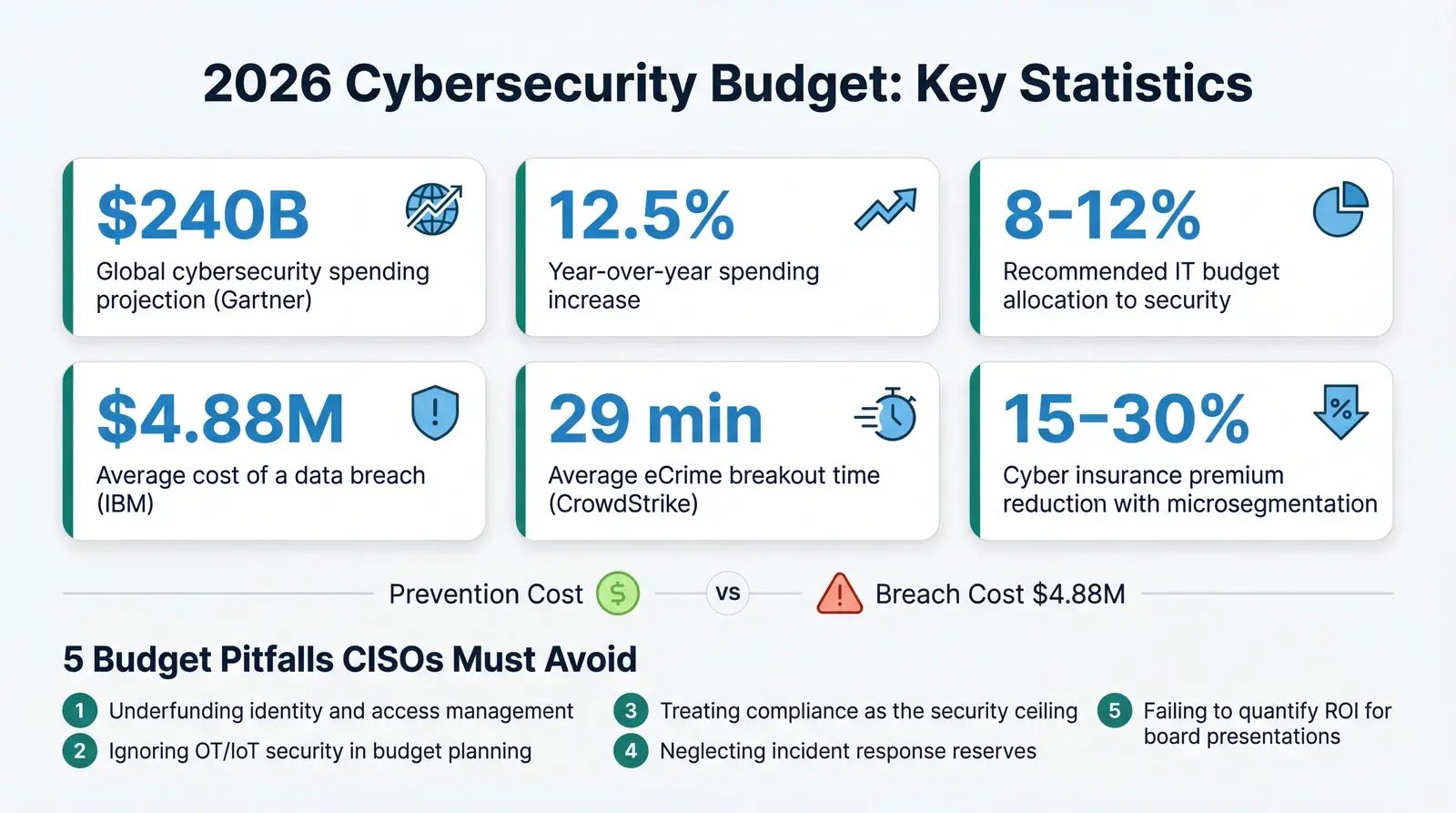
Seven Budget Pitfalls CISOs Must Avoid
- Over-emphasis on compliance alone. Investments that satisfy auditors without addressing real threats waste budget. Threat-based prioritization produces better outcomes.
- Insufficient integration planning. Point product sprawl creates operational complexity. Budget for professional services and integration costs, not just license fees.
- Technology purchases without operational readiness. If your team can't operate the tools you buy, you've created shelfware. Match technology to staffing realities.
- Inadequate vendor relationship management. Evaluate vendors on long-term roadmap alignment, not just current features. Negotiate consumption-based pricing where possible.
- Ignoring OT and IoT in the budget. With 670 new OT vulnerabilities in just the first half of 2025, treating operational technology as an afterthought is a high-risk strategy.
- Understaffing and over-reliance on tools. Only 11% of security executives feel adequately staffed. Automate where possible, but budget for the people needed to make decisions.
- Treating cyber insurance as a substitute for controls. Insurance carriers are tightening requirements and exclusions. Policies won't cover losses from known unpatched vulnerabilities or insufficient security posture.
Your Budget Planning Checklist
Strategic Planning
- Complete a risk assessment aligned to your threat profile
- Conduct a security maturity evaluation against NIST CSF 2.0 or CIS Controls
- Align budget with business objectives and digital transformation roadmap
- Establish success metrics and quarterly review cadence
Investment Prioritization
- Prioritize Zero Trust implementation based on the five-domain framework
- Allocate 15 to 20% of your cybersecurity budget to microsegmentation
- Balance technology and personnel investments (don't overspend on tools you can't operate)
- Plan for compliance requirements with specific deadlines (CMMC, CIRCIA, HIPAA)
Vendor Management
- Evaluate integration capabilities with your existing infrastructure
- Assess long-term roadmap alignment and product direction
- Negotiate consumption-based pricing and avoid long-term lock-in
- Plan for professional services costs alongside license fees
Implementation Planning
- Develop detailed deployment timelines with quarterly milestones
- Identify skill development requirements (cloud security, AI/ML, Zero Trust)
- Plan change management processes for new security controls
- Establish measurement frameworks before deployment, not after
Frequently Asked Questions
How much should a company spend on cybersecurity in 2026?
Most enterprises should allocate 8 to 12% of their total IT budget to cybersecurity, with high-threat industries (healthcare, financial services) targeting 10 to 15%. According to Gartner, this translates to roughly $240 billion in global spending for 2026. The allocation typically breaks down to 40% software, 30% personnel, 15% hardware, and 15% outsourced services. Your specific number depends on industry, regulatory obligations, and current maturity level.
What is the average cybersecurity budget breakdown?
According to Forrester's 2026 Budget Planning Guide, the average enterprise cybersecurity budget allocates approximately 40% to security software and platforms, 30% to internal personnel, 15% to hardware and appliances, and 15% to outsourced services. Training and governance consume an additional 5 to 10%. When including external contractors, personnel-related costs represent roughly 51% of total spending (NuHarbor Security). Software's share continues to grow as organizations shift from appliance-based to platform-based security models.
What are the projected global cybersecurity spending trends for 2026-2027?
Gartner projects global cybersecurity spending will reach $240 billion in 2026, up 12.5% from $213 billion in 2025. Forrester estimates the figure at $200 billion or more. This marks a significant acceleration from 2025's 4% growth rate, the slowest expansion in five years. Asia-Pacific leads with 22% of organizations expecting increases above 10%, followed by Europe at 14%. The growth is driven by AI-powered threats, ransomware escalation, and new regulatory mandates including CMMC 2.0 and CIRCIA.
How much does it cost to implement zero trust security?
Zero Trust implementation costs vary by scope and maturity. According to the CISA Zero Trust Maturity Model, moving from Traditional to Advanced maturity typically requires 12 to 24 months and 15 to 25% of your annual security budget. For a mid-sized enterprise, specific components include: IAM rollouts at $500,000 to $2 million (12 to 18 months), microsegmentation at $500,000 to $4 million, and CMMC Level 2 certification at $200,000 to several million. Modern platforms that work with existing infrastructure significantly reduce these costs.
What are the best cybersecurity investments for preventing lateral movement?
Network microsegmentation is the highest-impact investment for lateral movement prevention. It reduces vulnerable lateral movement paths by 70 to 90% and improves mean-time-to-contain from 4 to 6 hours to under 10 minutes. Complementary investments include phishing-resistant MFA (blocks 99% of bulk phishing), privileged access management, and EDR/XDR platforms. Organizations with microsegmentation experience 45% lower breach costs ($2.68 million versus $4.88 million). For a complete treatment, see our guide to 11 major cyberattacks using lateral movement.
How can CISOs justify cybersecurity budget increases to the board?
Lead with expected loss calculations: multiply annual breach probability (20 to 30%) by average breach cost ($4.88 million per IBM). Present the scenario planning framework (bear, base, bull cases) so the board chooses a risk tolerance, not a dollar figure. Use peer benchmarks (8 to 12% of IT budget, 10 to 15% for regulated industries) to anchor the conversation. Track KPIs quarterly: mean-time-to-detect, lateral movement reduction, compliance posture, and cost avoidance. The fact that 63% of organizations increase spending after a breach is the strongest argument for investing before one happens.
How much does microsegmentation cost to implement?
Implementation costs range from $500,000 to $4 million depending on organization size and complexity. Modern identity-based platforms deliver $3.50 in ROI for every $1 invested and achieve 76% TCO reduction compared to traditional firewall-based approaches. One global biopharma company reduced its segmentation project from $200 million to $50 million using a modern platform. Most organizations see a 12-month payback period. For detailed planning, see our microsegmentation budget planning and ROI guide.
What 2026 compliance deadlines are driving cybersecurity budget decisions?
Three deadlines demand immediate budget attention. CMMC 2.0 Phase 1 runs through late 2026 with certification costs of $200,000 to several million. CIRCIA reaches full effect in May 2026, requiring 72-hour incident reporting and costing $150,000 to $400,000 for reporting infrastructure. The proposed HIPAA Security Rule updates would make network segmentation mandatory rather than addressable. Additionally, IEC 62443 for manufacturing takes 18 to 36 months and $3 to 8 million. NIST CSF 2.0's "Govern" function now requires board-level security oversight.
Further Reading
- CISA Zero Trust Maturity Model (official framework)
- NIST Cybersecurity Framework 2.0 (official framework)
- IBM Cost of a Data Breach Report 2024 (primary source for breach cost data)
- Elisity Microsegmentation Buyer's Guide (ROI calculator and deployment checklist)
- Industrial Cybersecurity Budget Alignment Framework (manufacturing-specific planning)
- IEC 62443 Compliance White Paper (OT segmentation requirements)
About the Author
William Toll is VP of Marketing at Elisity, where he leads the company's go-to-market strategy for identity-based microsegmentation. With extensive experience in enterprise cybersecurity, Zero Trust architecture, and security operations, William writes about cybersecurity budget planning, risk management, and emerging threat trends for enterprise security leaders. His research-driven approach combines analyst data, industry benchmarks, and real-world deployment insights to help CISOs and IT leaders make informed investment decisions.
No Comments Yet
Let us know what you think